
Brothers and Sisters

When I first started researching what happens to the kids who are brought up in the orphanages in Ukraine, one of the most depressing facts I learned was that the problem becomes generational.  A young girl who was raised in the orphanage, gets out of the orphanage around age 16, gets pregnant, and sooner or later gives up on trying to be a mom, so her children end up in the orphanage as well.  Most of them can’t handle being parents because they have no example to follow and have no experience themselves.

komarivka 075Halya and Masha when we visited the hospital not long ago.

But in the transition homes, it’s a different story.

At Safe Haven, all the kids who come live in the home are Anya and Bogdon’s kids.  But Anya and Bogdon have their own biological boys.  Danya is seven and Pasha just turn 4 two weeks ago.  Anya told us once that she regularly teaches the older boys, especially about things like hygiene, by teaching Pasha how to keep himself clean.  All the kids watch as Anya and Bogdon are raising Pasha and Danya.  They learn from them how to discipline, how to show love, and so much more.

387440_321282864569931_1279754037_n
You can tell that Vitya loves being Pasha’s big brother.

And being big brothers and sisters they get to taste what if will be like to be parents themselves.  In fact, most of the families that are involved with Safe Haven have small children.  So especially on Sunday the house is full of kids under the age of four, and everyone has to pitch in with Sunday school from time to time. 

komarivka 059
Oksana babysits all the time.  At church, she immediately offers to help when one of the kids is crying.  She just loves kids.

And you can tell it makes a difference.

When we visited Tanya and Slavic in Western Ukraine we saw the same thing.  One of the ways their foster kids feel apart of the family is by taking care of Iliya, their two year old brother. 

vita and tanya and slavic 247Yanna is Tanya and Slavic’s foster daughter, and Iliya is their baby boy.

One of the main goals of the transition homes is to show kids what a family looks like, when they have never seen an example of a healthy family.  Being loved by someone in a mother and father role is a part of that.  But I think now that learning how to be a big brother or sister is just as crucial. 
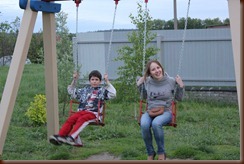
safe haven pizza 098

Ira and Danya.  Ira got married last summer and they want to have kids someday.  I think she’s gonna be a great mom.

One of our greatest hopes in working with transition homes is that we don’t just impact the life of the kids who live in the homes but make a change that play out for generations to come.  If Ira and Roma can be good parents, then their kids will be able to follow their example, and on and on.  So when I get to watch all of the kids who live with Anya and Bogdon, and see how good they are being big brothers and sisters, it gives me a lot of hope for the future generations, and reassures me that a Christ-centered transition home like Safe Haven and Tanya and Slavic’s home is a good thing.

Comments

Popular posts from this blog

The power of a hug

Three weeks ago at church, Masha sat next to me.   Masha is ten, has Downs Syndrome and is a fantastic hugger.  She just loves hugging.  So I try to always stop and hug her back.  During the service, she came in and sat between me and her dad, for a while she loved on her dad and then she leaned her head on my shoulder, so I leaned my head over onto hers, and she looked up at me with this big smile.  She reached around and gave me a shoulder hug, and then patted my head, and then rubbed my back for a few minutes.  I didn’t move the entire time because it just felt so good.  It was just simple, innocent affection, and it sent tingles up my spine.  If you don’t know what I’m talking about you need more hugs and back scratches. Human contact is so important.  That’s why I try and hug the kids when we go up to the orphanage.  These are just a few stories of some of the hugs I’ve given and gotten this past month, and why hugs are so imp...

The rain in Spain falls mainly on the plain: Why shopping is a pain in Ukraine.

I used to like shopping. I thought it was fun. I love closure, and so nothing was more satisfying than crossing items off a list. I enjoyed the experience of checking out new stuff, looking for bargains, and of course everyone knows that buying stuff feels good.   That was then. This is now. Shopping here is a pain. Let me explain (hey, I’m a poet and I don’t even realize it)! First, we don’t have a car. That means we are at the mercy of public transportation, and so we have to keep that in mind when choosing what store to go to. Is it close to a bus or metro stop? Do we have to transfer metro lines? When we lived in the city center, we were really close to two metro lines. We like this store called MegaMarket, and it was only a few stops away on the metro. So, we would grab our backpacks, walk a block to the metro, go down a ridiculously long escalator, then hop on a metro and ride a couple stops down.   Then we would walk a few blocks and there it was..…Megamarket! Second re...

The Costs of Dehumanization

  Our friends, Marina and Ira, have family in Russia.   Not long after the start of Russia’s full-scale invasion, they spoke with those family members.   Those in Russia expressed their disgust that people in Ukraine were eating children.   Marina and Ira’s reaction was naturally surprise and horror.   In the early days of the war, back in 2014, state-controlled Russian news agencies had started to run a story about a young boy that had been crucified in Ukraine’s eastern territories.  The narrative was that this was what Ukrainians were doing to Russian speakers.  It didn’t take long for the story to be debunked.  But this was primarily outside of Russia, most people within Russia kept hearing this story, and stories like it. Over the years, the stories grew to the point where Russian citizens were hearing that Ukrainians were regularly eating babies.   This is why Marina and Ira were having this conversation.  They told their r...